


 1913
1913
 Administrator
95
kalata
27
tsveti05
25
nadeto
18
Fifa_blg
13
bebkabebeto
8
lizard
7
zlostur
5
Yanitsa (sun)
5
rackitt

Описание:
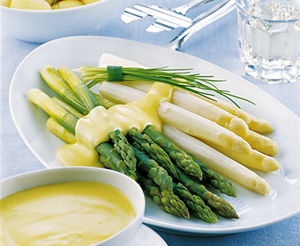
Сос холандез е смес от яйчен жълтък и масло, подправени най-често с лимонов сок, сол и малко бял пипер. На външен вид е светло-жълт и плътен, с кремообразна текстура. Вкусът му е богат и маслен, с леко свежи отсенки, добавени от лимоновият сок, не толкова остри, че да нарушат мекият вкус.
Холандез е един от петте в репертоара с главни сосове във френската висша кухня. Наречен е така заради слухът, че е бил създаден като имитация на Холандския сос по случай гостуването на холандският крал във Франция. Сосът Холандез е известен като ключова съставка в Яйцата по Бенедиктински, и често се използва като сос за зеленчуци на пара, като аспержи.
Има дебат кой първоначално е измислил сос Холандез. Някои историци вярват, че е създаден в Холандия и е внесен във Франция от хугенотите. Рецепта за сос Холандез се появява в холандска готварска книга на Carel Baten, която датира от 1593 г. През 1651 г., Франсоа Пиер Ла Варен описва сос, подобен на сос Холандез в своята култова готварска книга Le Cuisinier François: "avec du bon beurre frais, un peu de vinaigre, sel et muscade, et un jaune d’œuf pour lier la sauce" ("с добро и свежо масло, малко оцет, сол, и индийско орехче, и един яйчен жълтък за са оплътни соса"). Алан Дейвидсън отбелязва "sauce à la hollandoise" от François Marin's Les Dons de Comus (1758), но откакто сосът включва брашно, бульон, подправки, и без яйчени жълтъци, вече не може да се свърже със съвременният Холандез. However, Larousse Gastronomique states that, in former times fish 'à la hollandaise' was served with melted butter (implying that at one time egg yolks were not a part of the designation, Hollandaise). Davidson also quotes from Harold McGee (1990), who explains that eggs are not needed at all and proper emulsification can simply be created with butter. He also states that if one does wish to use eggs they are not needed in so great a quantity as normally called for in traditional recipes.
Сосът с жълтъци и масло се появява през 19 век. Although various sources say it was first known as "sauce Isigny" (a town in Normandy said to have been renowned for the quality of its butter), Isabella Beeton's Household Management had recipes in the first edition (1861) за "Холандски сос, за риба" (стр. 405) and its variant on the following page, "Green sauce, or Hollandaise verte". Нейните указания за Холандез са малко по-смели:
"Сложете всички съставки, освен лимоновият сок, в съд на водна баня, и разбърквайте постоянно. Когато сосът се сгъсти, свалете от огъня, тъй като не бива да се остави да заври..."
Hollandaise requires some skill and knowledge to prepare and hold. Properly made, it will be smooth and creamy with no hint of separation. The flavor will be rich and buttery, with a mild tang from the lemon juice. It is best prepared and served warm, but not hot.
Има няколко начина за приготвяне на сос Холандез. Всички методи изискват почти постоянно разбъркване с телена бъркалка. Първо жълтъкът и лимоновият сок (или вода) трябва да се разбият на водна баня, докато се получи светла и пенеста смес. then while whisking vigorously over warm water, becoming pale yellow and expanding two or three times in volume. Then removed from heat, warm (not hot) butter (or clarified butter) is added in dribbles. The sauce can be served promptly at room temperature, or having being brought to room temperature after refrigeration.
One family of methods involves acidifying the egg yolks to aid in the formation of an emulsion, either with lemon juice or vinegar. Escoffier uses a reduction of vinegar and water. Others use lemon juice or sherry. The acidified yolks are whisked gently over simmering water until they thicken and lighten in color (62 °C). Then, as with a mayonnaise, the emulsion is formed by very slowly whisking melted butter into it. Use of clarified butter is common. Some varieties of this preparation use water of various volumes and temperatures.
Alton Brown espouses quite a different method. The yolks, without acid, are cooked as above. Then the upper pan is removed from heat and cold cubed butter (unclarified) is whisked in, a few cubes at a time. The emulsion forms as the cubes melt. The pan is returned to heat only when the emulsion cools too much to melt more cubes. Lemon is used as a finishing flavor. This method takes more time than traditional methods, but is more reliable in that it is difficult to overheat the forming emulsion.
The above methods are known as "bain marie methods". Another family of methods uses a blender. Yolks are placed in a blender, then - at a temperature higher than appropriate for bain marie methods - butter is drizzled into the blender. Heat from the butter cooks the yolks. Blender methods are much quicker, although temperature control is difficult. The products of blender methods may be acceptable, but are generally considered to be inferior to the products of bain marie methods.
Joy of Cooking describes a preparation unlike all the above, using whole eggs, and slowly adding the egg mixture to melted butter over direct heat. It also includes variations incorporating sour cream and paprika, or cream and nutmeg.
Note that in all methods the temperature must be closely controlled. Too much heat and the yolks will curdle (82 °C) or an emulsion break (separate). Too little heat and an emulsion will fail to form, or (once formed), will solidify. Once the yolks are prepared, the sauce should be not much warmer than required to maintain the butter in a liquid state, that is, a little warmer than body temperature. Be sure to consider both the temperature of the yolks and emulsion and that of the melted butter. A finished sauce may be "held" in its emulsified state for several hours by keeping it warm. Success with freezing Hollandaise has been reported, but it is not widely practiced.
Нормалното съотношение на съставките е 1 жълтък: 4-6 с. л. масло. Овкусява се с лимонов сок и сол на вкус.
Холандез е основен вид сос, от който се правят различни други сосове, като се прибавят или се махат продукти. Следващият списък не изчерпва всички видове производни сосове.
Най-разпространеният дериват е сос Бернез. Приготвя се като се извади лимоновият сок или оцетът in a preparation with a strained reduction of vinegar, shallots, fresh chervil, fresh tarragon and (if to taste) crushed peppercorns. Alternatively, the flavorings may be added to a standard Hollandaise. Béarnaise and its children are often used on steak or other "assertive" grilled meats and fish.
Sauce Choron is a variation of béarnaise without tarragon or chervil, plus added tomato purée.
Sauce Foyot (a.k.a. Valois) is béarnaise with meat glaze (Glace de Viande) added.
Sauce Colbert is Sauce Foyot with the addition of reduced white wine.
Sauce Café de Paris is béarnaise with curry powder added.
Sauce Paloise is a version of béarnaise with mint substituted for tarragon.
Sauce au Vin Blanc (for fish) is produced by adding a reduction of white wine and fish stock to hollandaise.
Sauce Bavaroise is hollandaise with added cream, horseradish, and thyme.
Sauce Crème Fleurette is hollandaise with crème fraîche added.
Sauce Dijon, also known as Sauce Moutarde or Sauce Girondine, is hollandaise with Dijon mustard.
Sauce Maltaise is hollandaise to which blanched orange zest and the juice of blood orange is added.
Sauce Mousseline, also known as Sauce Chantilly, is produced by folding whipped cream into hollandaise.
If reduced sherry is first folded into the whipped cream, the result is Sauce Divine.
Madame Benoit's recipe for Mousseline uses whipped egg whites instead of whipped cream.
Sauce Noisette is a hollandaise variation made with browned butter (beurre noisette).
Снимка: www.kuechengoetter.de


